As oil becomes harder to find and produce, oil companies are increasingly dependent on riskier, more costly, and more polluting resources.
Private international oil companies have limited opportunities for growing their oil production. They have been forced by the growing power of national oil companies to go to the extremes to pursue oil wherever they can.
Tar sands, fracking and ultra-deepwater are examples of today’s extremes while the offshore Arctic and oil shale (kerogen) could be the future. But all of these resources are far more expensive, challenging, risky and polluting than the oil these companies were bringing into production a decade ago.
Driven by high oil prices, the oil industry has developed the technology to access billions of barrels of oil and vast quantities of natural gas that were previously considered inaccessible or uneconomic. This is adding to the vast pool of fossil fuels that we cannot afford to burn if we are to avoid extreme climate change.
Despite the climate limits, and despite the growing risks and costs, oil companies are committed to replenishing their reserves of oil and gas in order to remain attractive to investors. Their Reserves Replacement Ratio (RRR) is a key metric that investment analysts monitor in order to assess a company’s future.
But if oil is becoming costlier and riskier to produce, shouldn’t replacing reserves be viewed more critically when assessing company value? While RRR is just one of many metrics used by analysts, it is one that demands strong performance in something other than simple profit generation or return on investment. It demands the constant replenishment of an increasingly fraught commodity.
 Reserves Replacement Ratio in a Marginal Oil World
We examined the risks behind the oil industry’s relentless pursuit of reserves replacement in a report published in January 2011.
We found that at least four of the top six international oil companies significantly relied on tar sands reserves additions to support RRR rates in the previous five years. As a percentage of total liquids additions, tar sands represents between 26% and 71% of reserves additions for these four companies (see table).

The report also exposed the opacity of company reporting on reserves when it comes to different types of oil production.
With proven reserves already five times greater than climate limits can allow and risks and costs of exploiting those reserves ever more extreme, should the investment community continue to expect 100% RRR rates from the oil and gas industry?
We have also examined the risks behind the tar sands oil boom in several reports published since 2008.
We began by looking at the UK’s major oil companies (BP and Shell) and their emerging dependence on Canadian tar sands resources.
 Rising Risks in Tar Sands Investments (Sept. 2008) documented the potential headwinds facing the tar sands industry at the time, including escalating costs, labor shortages, legal challenges and regulatory and reputational risks.
The report formed the basis for a number of seminars and events in London throughout 2008-09, attended by institutional investors in BP and Shell.
 Shifting Sands (July 2009) discussed the impact of high oil prices on the long term viability of tar sands production and other costly forms of production.
High oil prices can destroy demand for oil through consumer response, by choking off economic growth, and by triggering government action to encourage efficiency and diversification.
Companies that are increasingly dependent on high cost resources are more exposed to the price volatility that accompanies an oil price rally.
This report also includes a look at energy security claims around tar sands and an examination of the carbon intensity of Shell’s oil reserves.
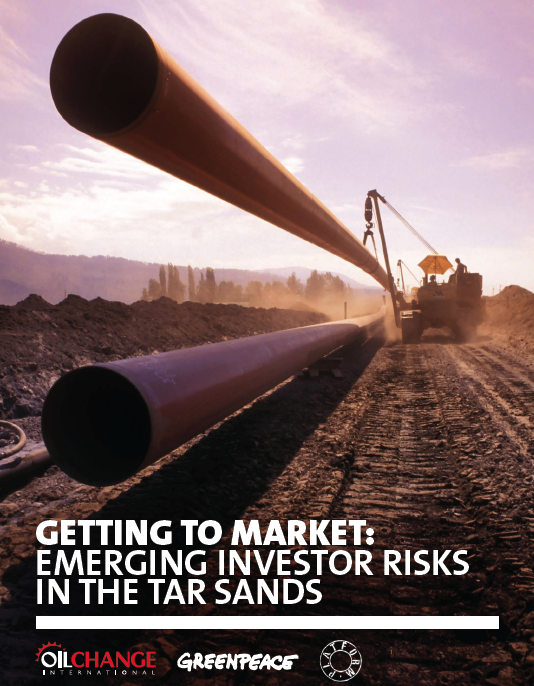 Getting to Market: Emerging Investor Risks in the Tar Sands (December 2011).
Shortly after President Obama announced a delay to the permitting of the Keystone XL tar sands pipeline, we documented the growing and substantial opposition to tar sands pipelines across North America.
In the report we highlight to investors that the enormous ambition of the tar sands industry cannot be fulfilled without all currently proposed pipelines going ahead. The mounting opposition to both tar sands extraction and the pipelines that would carry the product to market is proving to be a major threat to the realization of the industry’s dreams.
Since we published Getting to Market, investment analysts have been asking similar questions.
We continue to engage investors in a dialogue about the structural shifts facing the oil industry. We recognize that the oil industry generates significant profit for investors and that it is a challenge to find less damaging targets for the huge amounts of capital that these companies can soak up and deliver return on. However, in the long term, the risk profile of this industry is changing dramatically and we encourage investors to think about the implications of this and consider strategies to reduce their exposure to these risks.
This company has Owned the Government since the 1950’s. This Government has Sold Out this Country, and could care less what happens, as long as they can keep on putting money in their pockets. They couldn’t care less whether this corporations destroy, pollute, or endanger the population, and country, as long as the money is getting into their pockets. The Whole government is just a bunch of Hypocrites, out for their own gain, and hell with the people and country. It is not for the people, it’s by the Government, for the Government, NO MATTER WHICH WAY YOU LOOK AT IT.
They all talk a good game. Their slick ads — which they have the money to place almost everywhere thanks to record profits supplemented by government handouts, from the Money — They promise jobs, prosperity, energy security and a brighter future. Unfortunately, the only promise that they are likely to deliver on is the promise of profits — which won’t matter for your children, who will have to pay the price.
Just this summer, we’ve seen drought engulf the breadbasket of America. We’ve seen freak storms ravage the Midwest and east coast. All of these impacts are consistent with scientific predictions of climate change. Yet Exxon continues drilling and funding Congressional campaigns, (Republicans and Democrats) in order to get more subsidies to feed their addiction to their climate-destroying profits.
In June 2012, Rex Tillerson, the CEO of Exxon, acknowledged that burning of fossil fuels is warming the planet, but said society will be able to “adapt”. Tillerson blamed a public that is “ILLITERATE in science and math, a “LAZY” press, and advocacy groups that “MANUFACTURE FEAR” for misconceptions around the oil and gas industry. THE PRESS, NEWS PEOPLE ALL, JUST A BUNCH OF CHICKEN, AFRAID, RUNNING WITH THEIR HEAD UP THEIR ASS. REASON ALL YOU SEE ON THE NEWS IS WEATHER, NEWS OF MOVIES, ACTORS, AND BOOK WRITINGS. ALL NEWS CASTERS RUNNING AROUND WITH THEIR HEADS BETWEEN THEIR LEGS.
ALL NEWS ARE CHICKEN SHIT NEWS, ON ALL CHANNELS. ALL UNWORTHY OF WHATEVER THEY GET PAID.